- Delta, which can help you gauge the likelihood an option will expire in-the-money (ITM), meaning its strike price is below (for calls) or above (for puts) the underlying security’s market price.
- Gamma, which can help you estimate how much the Delta might change if the stock price changes.
- Theta, which can help you measure how much value an option might lose each day as it approaches expiration.
- Vega, which can help you understand how sensitive an option might be to large price swings in the underlying stock.
- Rho, which can help you simulate the effect of interest rate changes on an option.
Now that you’ve been introduced, we can explore these calculations in more detail.
Delta
Delta measures how much an option’s price can be expected to move for every $1 change in the price of the underlying security or index. For example, a Delta of 0.40 means the option’s price will theoretically move $0.40 for every $1 change in the price of the underlying stock or index. As you might guess, this means the higher the Delta, the bigger the price change.
Traders often use Delta to predict whether a given option will expire ITM. So, a Delta of 0.40 is taken to mean that at that moment in time, the option has about a 40% chance of being ITM at expiration. This doesn’t mean higher-Delta options are always profitable. After all, if you paid a large premium for an option that expires ITM, you might not make any money.
You can also think of Delta as the number of shares of the underlying stock the option behaves like. So, a Delta of 0.40 suggests that given a $1 move in the underlying stock, the option will likely gain or lose about the same amount of money as 40 shares of the stock.
Call options
- Call options have a positive Delta that can range from 0.00 to 1.00.
- At-the-money options usually have a Delta near 0.50.
- The Delta will increase (and approach 1.00) as the option gets deeper ITM.
- The Delta of ITM call options will get closer to 1.00 as expiration approaches.
- The Delta of out-of-the-money call options will get closer to 0.00 as expiration approaches.
Put options
- Put options have a negative Delta that can range from 0.00 to –1.00.
- At-the-money options usually have a Delta near –0.50.
- The Delta will decrease (and approach –1.00) as the option gets deeper ITM.
- The Delta of ITM put options will get closer to –1.00 as expiration approaches.
- The Delta of out-of-the-money put options will get closer to 0.00 as expiration approaches.
Gamma
Where Delta is a snapshot in time, Gamma measures the rate of change in an option’s Delta over time. If you remember high school physics class, you can think of Delta as speed and Gamma as acceleration. In practice, Gamma is the rate of change in an option’s Delta per $1 change in the price of the underlying stock.
In the example above, we imagined an option with a Delta of .40. If the underlying stock moves $1 and the option moves $.40 along with it, the option’s Delta is no longer 0.40. Why? This $1 move would mean the call option is now even deeper ITM, and so its Delta should move even closer to 1.00. So, let’s assume that as a result the Delta is now 0.55. The change in Delta from 0.40 to 0.55 is 0.15—this is the option’s Gamma.
Because Delta can’t exceed 1.00, Gamma decreases as an option gets further ITM and Delta approaches 1.00. After all, there’s less room for acceleration as you approach top speed.
Theta
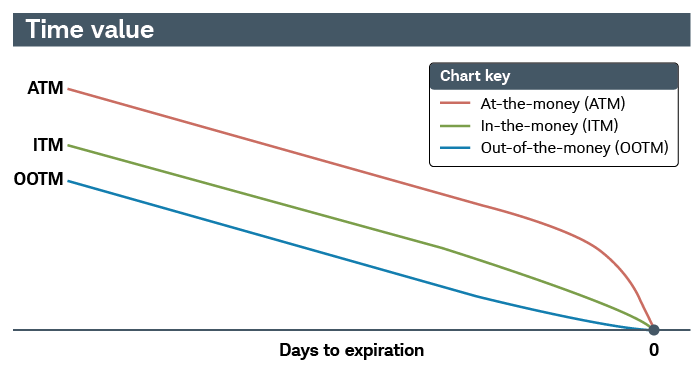
Theta tells you how much the price of an option should decrease each day as the option nears expiration, if all other factors remain the same. This kind of price erosion over time is known as time decay.
Time-value erosion is not linear, meaning the price erosion of at-the-money (ATM), just slightly out-of-the-money, and ITM options generally increases as expiration approaches, while that of far out-of-the-money (OOTM) options generally decreases as expiration approaches.
Time-value erosion
Source: Schwab Center for Financial Research
Vega
Vega measures the rate of change in an option’s price per one-percentage-point change in the implied volatility of the underlying stock. (There’s more on implied volatility below.) While Vega is not a real Greek letter, it is intended to tell you how much an option’s price should move when the volatility of the underlying security or index increases or decreases.
More about Vega:
- Volatility is one of the most important factors affecting the value of options.
- A drop in Vega will typically cause both calls and puts to lose value.
- An increase in Vega will typically cause both calls and puts to gain value.
Neglecting Vega can cause you to potentially overpay when buying options. All other factors being equal, when determining strategy, consider buying options when Vega is below “normal” levels and selling options when Vega is above “normal” levels. One way to determine this is to compare the historical volatility to the implied volatility. Chart studies for both values are available on StreetSmart Edge®.
Rho
Rho measures the expected change in an option’s price per one-percentage-point change in interest rates. It tells you how much the price of an option should rise or fall if the risk-free interest rate (U.S. Treasury-bills)* increases or decreases.
More about Rho:
- As interest rates increase, the value of call options will generally increase.
- As interest rates increase, the value of put options will usually decrease.
- For these reasons, call options have positive Rho and put options have negative Rho.
Consider a hypothetical stock that’s trading exactly at its strike price. If the stock is trading at $25, the 25 calls and the 25 puts would both be exactly at the money. You might see the calls trading at, say, $0.60, while the puts could be trading at $0.50. When interest rates are low, the price difference between puts and calls will be relatively small. If interest rates increase, the gap will get wider—calls will become more expensive and puts will become less so.
Rho is generally not a huge factor in the price of an option, but should be considered if prevailing interest rates are expected to change, such as just before a Federal Open Market Committee (FOMC) meeting.
 NYC Journals